Thursday, 18 November 2010

The New Face of Shopping


I wonder, do we really need or want to be shopping in the dark!


Whilst pretending to look outside onto the waves rolling in on a Californian beach


Then there is the sewing machine shop! 
No! just a guise to draw attention


To what is inside

Spotted these new stores while visiting our favourite shopping mall last week.
The only downside to this mall for us is that it is the other side of the River Thames.
The lesson in this story is to take note of the weather forecast before travelling.
The gales and highwinds forecast where enough to necessitate the closing of the bridge whilst we were there.

It took two and a half hours of queueing to just get onto the M25 when we left in order to go through the tunnel to get back northside. We could not move in any direction as everywhere was gridlocked.
Very different to the trip we made 2 days earlier taking 25 minutes to get home at
7.30 pm in normal weather

Saturday, 13 November 2010

Trinity College - Cambridge Pt.3

We will take a visit to Cambridge again with this post and this time we will go into the grounds and chapel of Trinity College.

Trinity is the largest college in the University. Today it consists of a Master; about 160 fellows, most of whom are engaged in teaching; about 320 postgraduate students; and about 650 undergraduates.
The King's Hall received it's charter in 1337, and was given buildings by King Edward III in what are now the northern parts of the Great Court. Michaelhouse, founded in 1324 by Hervey de Stanton, Chancellor of the Exchequer to Edward II, occupied buildings to the south.


We will enter by the Great Gate where we see a statue of the College's founder King Henry VIII


Here on the west side facing inwards are statues of King James I, flanked by his wife, Anne of Denmark, and his heir, Prince Charles (later King Charles I)


The public are not allowed access to student accommodation areas naturally. Among former occupants of the Great Court
Sir Issac Newton (1642 -1727), mathematician and natural philosopher, lived in rooms on the first floor between the Great Gate and the Chapel. In what was once his garden, between the cobbles and the Chapel, is an apple tree descended from one at his home in Woolsthorpe in Lincolnshire, and planted in 1954.
(See an earlier post on Woolsthorpe)


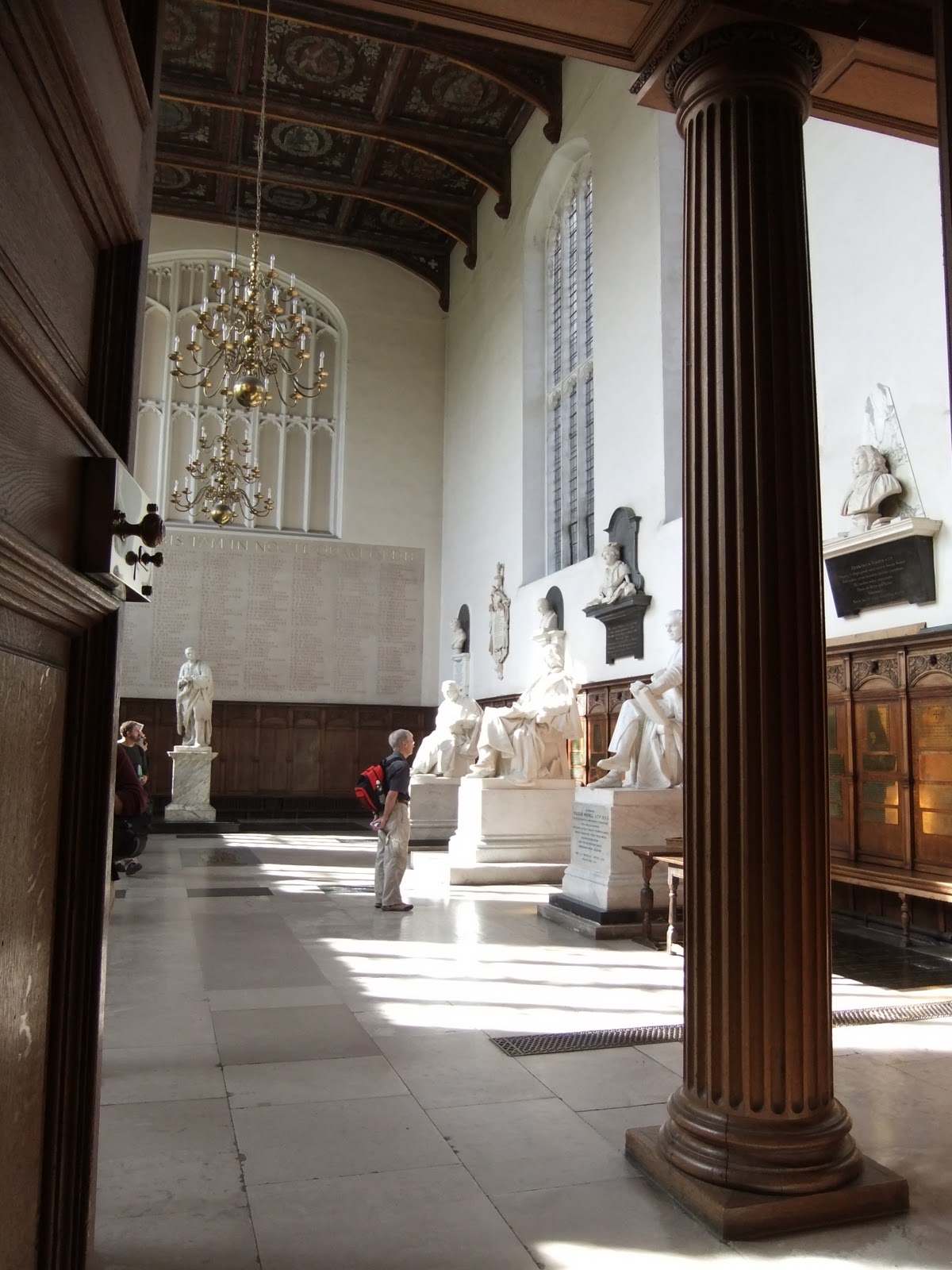
We will now go into the Chapel via. the outer hall
Newton

Tennyson


More stained glass windows which all tell their own story

Alan is pointing to the organ pipes


Like many other college chapels, it is divided by the organ screen into two; the anti-chapel and the chapel. Services are held here daily in term-time. Evensong has been held here regularly since the founding of the chapel.


Looking back into the hall
No forgetting the hall ceiling with it's many crests 


The novelist W.M.Thackeray (1811-63), author of Vanity Fair, lived on the ground floor in what is now part of the Porter's Lodge.

Hope you enjoyed your visit to another college
We visited only 3 this day but more Cambridge photos to come 


Saturday, 6 November 2010

Stunning Autumn Colours - Pt.2

Yes, we have had a particularly good year for Autumn colours. A wet Summer and sunny October. Herewith a little science for any who do not know: 
 The colours of Autumn leaves are caused by yellow, orange and red pigments within them,which, in fact, exist all year. These colours are usually masked by chlorophyll, the green pigment which converts sunlight into the sugars that nourish the tree.
 Throughout the summer, the chlorophyll is replenished by the tree itself. However as the days become shorter at the start of autumn, the tree takes it's cue to start preparing for the colder winter months. As a result, it stops replenishing the chlorophyll and the green pigment begins to disappear.
 Once the amount of daylight falls below a threshold point - the exact amount varies from species to species - cells near the junction of each leaf and it's twig start to divide rapidly to form a dry, corky plug called an abscission layer. It is this plug that blocks the passage of sugars from the leaf to the rest of the tree, but also prevents chlorophyll being replenished.
 In just a few weeks, the green pigment breaks down completely from the leaves to expose the colours that were previously hidden from view.
 The orange hues of autumn seen in beech trees are carotenoids that give carrots and pumpkins their colour.
 The yellow of lime trees are xanthophylls,  a pigment found in banana skins, egg yolks and human blood plasma.
 A class of pigments called anthocyanins create the reds of acers and ornmental cherry trees.

The end result of all this of  course is sheer breath taking artistry for us as we see here in Sheffield Park Gardens.